
Archive for films

The Twilight Division: A Cinematic Proposal

OK, so I like the Twilight films. The actors and the scenery are pretty, the plot is a perfectly good vampire story, and I like the way Kristen Stewart says everything in a flat monotone (I genuinely do) and the way Robert Pattinson has cute teeth and seems to be taking it all much less seriously than everyone else. Also, Michael Sheen.

I’d like to think that in a few years’ time, this will be roughly the attitude most people have towards the films. At the moment, of course, it’s difficult to fight one’s way through the clouds of obsessive adulation on the one hand and hostile mockery on the other to form any kind of measured opinion; and having managed to achieve one, I intend to guard it carefully, like a fragile glass jar filled with mild but sparkly enjoyment.

All of which is to say that last weekend I went to see Breaking Dawn 2 (The One Where Everything Wraps Up, More Or Less) and liked it. So did the majority of the audience, or at least I assume they did, since they didn’t get up and leave. Well, apart from all the people sitting in my row, who did in fact get up and leave as soon as the film started. But I’m assuming it was either that they were in the wrong screen, or that I have some form of personal problem that someone should have told me about by now. Or it was a form of performance art/creative protest against the Twilight franchise. Or perhaps they’d once been bitten by a snow-covered landscape and found it all too much to take.

Anyway. The point is, Twilight audiences are a sharply divided group, and all their permutations were reflected in my screening. At the back there were quite a lot of very, very excited teenage girls, who cheered and booed and generally really got into it all, which was rather endearing (I felt, in the patronising way of a woman in her late 30s going to see a teen vampire flm on her own). At the front were a handful of people who found the film hilariously worthy of mockery. In the middle were some, like me, who had just come to see a film they expected to enjoy.

While noting all this, I had a thought. You know how cinema listings these days often give you a choice of screening types? There are Over 18 screenings. (I initially assumed these were films with sex and swearing specially added for your viewing pleasure, but I think they’re probably just the same film with no under-18s admitted. Bah.) There are Parent and Baby screenings. And of course there’s 3D and IMAX. But there are important demographics being ignored here, and with modern culture becoming increasingly customised and tailored to niche markets, I think it’s time we got a few more options. This should be called The Twilight Division in honour of the founding franchise, and in the case of Breaking Dawn II, the screenings we needed were, at the very least:

  • Twilight (Mocking)
  • Twilight (Fan)

These two categories are in effect watching two completely different films, and should be treated as such. Let the fans enjoy themselves in their own way; let the mockers have fun in theirs. Putting the two together can only lead to friction, shouting and possibly some kind of West Side Story-type riot afterwards.

And yet, is this binary division enough? Some mockers like the films but find their enjoyment enhanced with a bit of laughter. Some genuinely just want to make fun of the entire enterprise (and are prepared to pay good money to do so, apparently). Some fans want to appreciate Bella and Edward/Jacob in reverent silence, some want to cheer every time Tayler Lautner displays any skin whatsoever. Some fall outside the binary altogether. So we need to subdivide. For example:

  • Twilight (Mocking: Affectionate)
  • Twilight (Mocking: Hostile)
  • Twilight (Fan: Quiet)
  • Twilight (Fan: Excited)
  • Twilight (Fan: Screaming Uncontrollably Throughout)
  • Twilight (In Wrong Screen, Meant To See Skyfall)
  • Twilight (Just Likes The Pretty Trees, Yes OK And Also Topless Jacob Is OK I Guess But Don’t Tell Anyone I Said So)

And even this ignores the various factions within each subdivision. Given a big enough set of screens, you could easily provide for:

  • Twilight (Mocking: Affectionate: Secretly Team Edward)
  • Twilight (Mocking: Affectionate: Secretly Team Jacob)
  • Twilight (Mocking: Affectionate: Secretly Team Bella)
  • Twilight (Mocking: Affectionate: Secretly Team Alice)
  • Twilight (Mocking: Affectionate: Secretly Team Michael Sheen’s Character, Whatever His Name Is)
  • Twilight (Mocking: Affectionate: Secretly Team Jessica And Very Disappointed in Breaking Dawn II)
  • Twilight (Mocking: Affectionate: Actually Genuinely Loves The Franchise But Can’t Admit It To Their Friends)
  • Twilight (Mocking: Affectionate: Owns All The Merchandise But Definitely In An Ironic Way)

And so on.

Alternatively, of course, you could have one big screen, but make it like a silent disco: everyone gets noise-cancelling headphones so they can’t hear anyone else’s reaction. Yes, you lose some of the cinema-going experience. But at least the Mocking, Affectionate: Secretly Team Bella and the Mocking, Affectionate: Secretly Team Alice factions won’t end up in a choreographed fist-fight. Or maybe that’s actually a downside. My money’s on the Alices.

(Made with MakeBeliefsComicx)

Share

Smashed and Gleeful: some notes on a tiny genre

US show-about-a-show Smash starts on Sky Atlantic this weekend. Like Glee, to which it is constantly being compared, it’s a TV series with musical numbers. But that’s the same as saying that Agatha Christie’s Poirot and 24 are both cop shows. In a world with as many musical TV shows as there are detective series or thrillers – a beautiful, shiny world that sadly only exists in my head – it would be obvious that Smash and Glee are quite distinct examples of their genre.
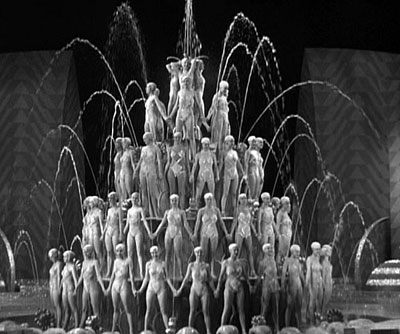
This shot, for example, could only have come from a Busby Berkeley show.

Film musicals don’t necessarily have clearly delineated subgenres. Instead they tend to be categorised by their star or director or choreographer: Vincente Minnelli musicals, Bob Fosse musicals, Busby Berkeley musicals. But you could also categorise them in other ways, for example:

- By degree of realism: do people just burst into song (e.g. Grease) or are they always on stage performing (e.g. 42nd Street)?

- By level of comedy vs tragedy: can you be certain that everything will work out in the end, as in all the Astaire-Rogers films; or will the climax be sad or ambiguous, as in Dancer in the Dark or Hedwig and the Angry Inch?

- By family-friendliness: Mary Poppins and Annie are at one end of this sliding scale, Rocky Horror and Cabaret at the other. You can roughly calculate this by counting up the number of children in major roles.

- By old versus new, which often makes a major difference in tone. The tropes of classic 1930s musicals and 1950s musicals are well known; more recently, there’s less homogeneity except for a tendency – like all other film genres – towards more sex and swearing.

Smash and Glee are far from polar opposites, but they occupy quite different positions in the musical oeuvre. With this in mind, I shall therefore attempt to weigh Smash and Glee against each other using my own personal totally-not-made-up-on-the-spot categorisations.

Grown-Upness: Glee is a high school show. Smash is an adult drama, albeit one set in the not-terribly-adult world of making a Broadway musical. This is the basic and important difference between them. Smash has exactly one teenage character and he’s minor and annoying; Glee, of course, is primarily made up of teens. Themes such as coming to terms with sexuality and deciding what you want to do in life, so central to Glee, are mainly absent in Smash. Smash’s characters mostly know who they are and what they want (fame, success, sex, money, everyone else losing); it’s how to get it that frustrates them.

Having said this, I should note that the family-friendliness of the shows is roughly equal, in that both have sex and sexual themes in them. (Although not swearing. One of the quirks of American TV networks, I think?)

Gayness: Glee is definitely gayer than Smash. The number of LGB characters is about the same, but Glee’s queer characters feel queerer. Possibly because they’re teenagers in a small town rather than adults on Broadway, so their sexuality stands out more.

Note: Smash contains a major character, Derek (Jack Davenport) who expresses some mildly homophobic views. I think this is probably quite realistic even for Broadway, so I’m happy that they’ve done this. I don’t get the impression that he actually dislikes gay men, for what it’s worth, more that he clashes with one specific one and likes shocking people. I admit that this may because I am blinded by Jack Davenport’s stubbly, irritable, butch handsomeness.
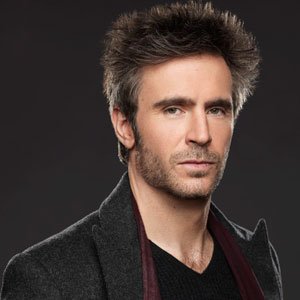
I mean, look.


Eye Candy, or some less shallow term that basically means the same thing: It depends on taste, and maybe I’m biased by the relative novelty of Smash, but Jack Davenport and Megan Hilty (playing Ivy) win for me. Though Glee has a bigger and younger cast, of course, and I wouldn’t want to do down any ensemble that has Mark Salling (Puck) and Naya Rivera (Santana) in it. And obviously, Heather Morris dancing is the best thing ever. So on the whole, it’s a tie.

Most Musical Numbers: Glee wins outright here, though I may be in a minority for thinking that more is better. I have been bemused to discover that there are people who watch Glee but don’t like the musical numbers, which is like watching The West Wing but tuning out all the politics. Personally, I am a musicals geek and I want as much singing as possible: an entirely sung-through TV show would suit me fine. So for me, Smash doesn’t have enough songs in it. It does have more original songs, which again you may or may not see as a plus. And is more showtune-oriented. But there’s still too much talking for my taste.

Realism: A quick rant here. If you think that people suddenly bursting into song in hallways is silly and offputting, that’s fine, but you must understand – and I can’t believe I’m having to say this at all - that’s what musicals do. It’s like maverick cops or slow-moving zombies: some tropes are intrinsically part of the genre and bitching about them is pointless, not to mention annoying. (Affectionate mocking or subversion of them is absolutely fine, of course.)

All of which is to say that I love it when people burst into musical numbers, especially when they feature an invisible orchestra and a large cast of synchronised background dancers, and I think real life should be more like that, frankly. Glee and Smash both run the gamut from this to practically-realistic numbers sung on stage, and that suits me fine.

Plot and consistency: I’ve read a lot of reviews of both shows, and critics tend to complain that both lack focus, consistency, coherent plot strands that make sense etc. I don’t deny it. But go watch Top Hat, one of the most beloved musicals of all time, and then talk to me*. Musicals have never particularly tried to make sense. That’s not what they’re for. They’re for the moment, and if the moment works, then the show works.

Moreover, how much sense does Castle or House or, I don’t know, Heroes really make? (I don’t know the answer to this. I’m a bit vague on shows that don’t have songs in them, unless they’re True Blood. But I’m going to assume that none of them achieve 100% sensibleness, and that they’d be less fun if they did.)

Finally, a recommendation: if you like adult TV shows with musical numbers, and especially if you actually do want a plot as well, you’re going to want to watch Blackpool. It’s a six-part British show from 2004, it’s got David Tennant dancing in it, and it’s so good I think I might need to go and watch it right now.


*The plot of Top Hat rests on Ginger Rogers believing that Fred Astaire is the husband of her best friend and thus romantically unavailable, despite the fact that she spends several days with him, the best friend, and the best friend’s actual husband, who is himself Fred Astaire’s best friend. So she impulsively marries her narcissistic cod-Italian tailor, but it’s OK because the vicar who married them was actually the butler of Fred Astaire’s best friend and not a vicar at all. I adore Top Hat, but I have never watched it without shouting at the screen “JUST TALK TO EACH OTHER!” 

Share

Tinker, Tailor, Soldier, Mum

(First published on the Huffington Post)

Two major films were released last Friday, both adapted from bestselling novels published in previous decades.

Firstly, there’s I Don’t Know How She Did It, from the novel by Joan Le Carré. This gritty 1970s-set thriller features retired spy Georgina Smiley, pulled back into a world of secrets to find the woman who betrayed the Service – but which woman is it?

It’s not easy juggling a lifestyle that includes ultra-secret spying, being separated from one’s cheating husband and walking down grimy London streets looking pensive. Played by Helen Mirren with dignity, intelligence and a hint of cruelty, the character of Georgina has reignited the debates first sparked by the novel.

Should women be spies? Is it really a suitable profession for a sex notorious for backstabbing, gossiping and betraying each other at the first opportunity? The media has been overwhelmed with articles on spying, and particularly on how the career can be combined with a family life when it is by nature a secretive job. One feels sympathy for Georgina’s cheating husband Alex: it’s clear she was spending all her time at the office in a miasma of smoke having furtive conversations with other women whose marriages were also suffering. Her return from retirement to take on yet another murky, complicated investigation illustrates where her loyalties lie. No wonder Alex strayed.

And, as many articles have pointed out, what about all the spies and spymasters who just get on with spying and spymastering with far fewer resources than Georgina? Georgina is at the top of her profession, or at least was once, and appears to be relatively wealthy. Moreover, she has unfailing support from her friends and colleagues (admittedly, mainly secret and unofficial support), such as Peta Guillem (played by the redoubtable Benedictine Cumberbatch, famous for her portrayal of detective Shirley Holmes). Ultimately, Georgina fails to represent the real workday life of the spy, making it hard to empathise with her.

The week’s second novel adaptation is Worker, Lover, Husband, Dad from the 1990s Alastair Pearson book. This is a lighter, but still significant, drama about Kevin Reddy, a New York dad who juggles three children, a high-flying job with constant business travel, and a potential love interest. Media interest in this film has mainly focused on the high-quality acting by hit sitcom star Matthew Perry, who ably portrays the harassed father as he attempts to fulfil the four title roles and keep everyone happy.

However, the popular consensus is that the film lacks an element of tension, since everyone knows men can juggle any number of roles with ease, particularly if they have – as Reddy does – a supportive wife who helps with the children, arranges his social life and turns an understanding blind eye to his potential infidelities.

Ultimately, I Don’t Know How She Did It is a women’s film: dark and low-key, it reveals its secrets slowly and conversationally. Women will appreciate the fact that virtually everyone in the film is female, and the emphasis on solving problems through talking.

Worker, Lover, Husband, Dad is aimed more at the male market – many middle-class men will empathise with the travails of Reddy as he attempts to make a lot of money to maintain his already luxurious lifestyle while trying to make sure at least one of his children remembers what his name is.

Next week, we look at the return of Danielle Craig playing the ever-appealing Jane Bond, and we talk about the film version of James Eyre – the story of the young orphan tutor James and his imperious older mistress Miss Rochester with a dark secret in the attic.

A post about this post

Share