
US show-about-a-show Smash starts on Sky Atlantic this weekend. Like Glee, to which it is constantly being compared, it’s a TV series with musical numbers. But that’s the same as saying that Agatha Christie’s Poirot and 24 are both cop shows. In a world with as many musical TV shows as there are detective series or thrillers – a beautiful, shiny world that sadly only exists in my head – it would be obvious that Smash and Glee are quite distinct examples of their genre.
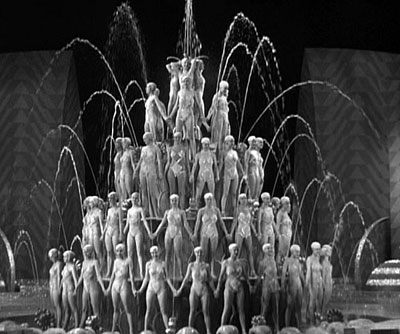
This shot, for example, could only have come from a Busby Berkeley show.
Film musicals don’t necessarily have clearly delineated subgenres. Instead they tend to be categorised by their star or director or choreographer: Vincente Minnelli musicals, Bob Fosse musicals, Busby Berkeley musicals. But you could also categorise them in other ways, for example:
- By degree of realism: do people just burst into song (e.g. Grease) or are they always on stage performing (e.g. 42nd Street)?
- By level of comedy vs tragedy: can you be certain that everything will work out in the end, as in all the Astaire-Rogers films; or will the climax be sad or ambiguous, as in Dancer in the Dark or Hedwig and the Angry Inch?
- By family-friendliness: Mary Poppins and Annie are at one end of this sliding scale, Rocky Horror and Cabaret at the other. You can roughly calculate this by counting up the number of children in major roles.
- By old versus new, which often makes a major difference in tone. The tropes of classic 1930s musicals and 1950s musicals are well known; more recently, there’s less homogeneity except for a tendency – like all other film genres – towards more sex and swearing.
Smash and Glee are far from polar opposites, but they occupy quite different positions in the musical oeuvre. With this in mind, I shall therefore attempt to weigh Smash and Glee against each other using my own personal totally-not-made-up-on-the-spot categorisations.
Grown-Upness: Glee is a high school show. Smash is an adult drama, albeit one set in the not-terribly-adult world of making a Broadway musical. This is the basic and important difference between them. Smash has exactly one teenage character and he’s minor and annoying; Glee, of course, is primarily made up of teens. Themes such as coming to terms with sexuality and deciding what you want to do in life, so central to Glee, are mainly absent in Smash. Smash’s characters mostly know who they are and what they want (fame, success, sex, money, everyone else losing); it’s how to get it that frustrates them.
Having said this, I should note that the family-friendliness of the shows is roughly equal, in that both have sex and sexual themes in them. (Although not swearing. One of the quirks of American TV networks, I think?)
Gayness: Glee is definitely gayer than Smash. The number of LGB characters is about the same, but Glee’s queer characters feel queerer. Possibly because they’re teenagers in a small town rather than adults on Broadway, so their sexuality stands out more.
Note: Smash contains a major character, Derek (Jack Davenport) who expresses some mildly homophobic views. I think this is probably quite realistic even for Broadway, so I’m happy that they’ve done this. I don’t get the impression that he actually dislikes gay men, for what it’s worth, more that he clashes with one specific one and likes shocking people. I admit that this may because I am blinded by Jack Davenport’s stubbly, irritable, butch handsomeness.
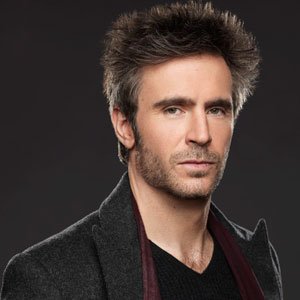
I mean, look.
Eye Candy, or some less shallow term that basically means the same thing: It depends on taste, and maybe I’m biased by the relative novelty of Smash, but Jack Davenport and Megan Hilty (playing Ivy) win for me. Though Glee has a bigger and younger cast, of course, and I wouldn’t want to do down any ensemble that has Mark Salling (Puck) and Naya Rivera (Santana) in it. And obviously, Heather Morris dancing is the best thing ever. So on the whole, it’s a tie.
Most Musical Numbers: Glee wins outright here, though I may be in a minority for thinking that more is better. I have been bemused to discover that there are people who watch Glee but don’t like the musical numbers, which is like watching The West Wing but tuning out all the politics. Personally, I am a musicals geek and I want as much singing as possible: an entirely sung-through TV show would suit me fine. So for me, Smash doesn’t have enough songs in it. It does have more original songs, which again you may or may not see as a plus. And is more showtune-oriented. But there’s still too much talking for my taste.
Realism: A quick rant here. If you think that people suddenly bursting into song in hallways is silly and offputting, that’s fine, but you must understand – and I can’t believe I’m having to say this at all - that’s what musicals do. It’s like maverick cops or slow-moving zombies: some tropes are intrinsically part of the genre and bitching about them is pointless, not to mention annoying. (Affectionate mocking or subversion of them is absolutely fine, of course.)
All of which is to say that I love it when people burst into musical numbers, especially when they feature an invisible orchestra and a large cast of synchronised background dancers, and I think real life should be more like that, frankly. Glee and Smash both run the gamut from this to practically-realistic numbers sung on stage, and that suits me fine.
Plot and consistency: I’ve read a lot of reviews of both shows, and critics tend to complain that both lack focus, consistency, coherent plot strands that make sense etc. I don’t deny it. But go watch Top Hat, one of the most beloved musicals of all time, and then talk to me*. Musicals have never particularly tried to make sense. That’s not what they’re for. They’re for the moment, and if the moment works, then the show works.
Moreover, how much sense does Castle or House or, I don’t know, Heroes really make? (I don’t know the answer to this. I’m a bit vague on shows that don’t have songs in them, unless they’re True Blood. But I’m going to assume that none of them achieve 100% sensibleness, and that they’d be less fun if they did.)
Finally, a recommendation: if you like adult TV shows with musical numbers, and especially if you actually do want a plot as well, you’re going to want to watch Blackpool. It’s a six-part British show from 2004, it’s got David Tennant dancing in it, and it’s so good I think I might need to go and watch it right now.
*The plot of Top Hat rests on Ginger Rogers believing that Fred Astaire is the husband of her best friend and thus romantically unavailable, despite the fact that she spends several days with him, the best friend, and the best friend’s actual husband, who is himself Fred Astaire’s best friend. So she impulsively marries her narcissistic cod-Italian tailor, but it’s OK because the vicar who married them was actually the butler of Fred Astaire’s best friend and not a vicar at all. I adore Top Hat, but I have never watched it without shouting at the screen “JUST TALK TO EACH OTHER!”



